Wednesday, 12 January 2022

Hull Bottom Panels | Final Coat of Gloss?

When the test panels on the hull were dry I compared the finishes. Foam and bristle brushes both produced good results but the foam achieved a thinner coat, so that was the way ahead.

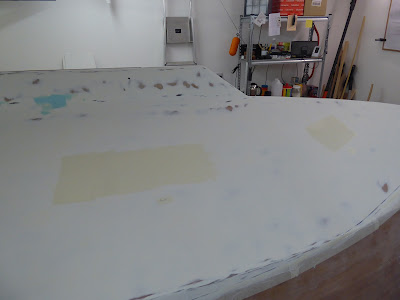
The bottom panels were then carefully sanded with P220 and then P280 grit to obtain a good, smooth surface. This is what they looked like.


I washed the panels and allowed them to dry before applying what I hoped would be the seventh and final coat of gloss.

I added 10% paint conditioner to the gloss to minimise brush marks, based on previous experiments. Here is the result.


It did not look too bad at all! There are some minute marks and dust particles which I will polish out later, but on the whole I think that it turned out OK.

So I summoned up the courage to peel off the masking tape. I was a bit worried that it would tear the paint and leave a jagged edge, but it came off beautifully.

Like this.


Leaving a perfectly clean and sharp edge. It's great stuff, this 3M tape!

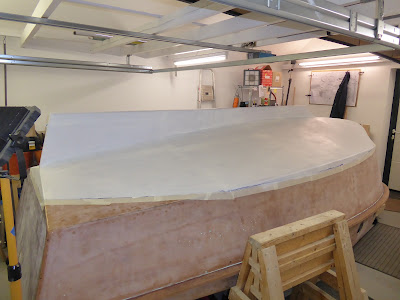
This is what the bottom of the hull looks like now.


We're definitely getting there!


Festive Spirit!

Christmas and New Year came and went, and predictably boatbuilding stopped for the holiday.

Instead we ate and drank too much, as always.

Including this bottle of delicious Boatyard Gin, courtesy of my son.


A close look reveals that it is nearly empty ... cheers Nick!


Sunday, 19 December 2021

Hull Bottom Panels | It's All Coming Off!

Examination of the hull the following day revealed, as suspected, that the first coat of gloss on the bottom panels had not been a great success.

Brush marks in the primer showed clearly through the gloss, and although it wasn't really awful I knew it could be so much better.

I could also see where the wet edge was, well, no longer wet and had dried in numerous places. Not good.

The level of finish would have been OK in a house interior, with an eggshell or satin finish, but it wasn't nice enough for the high gloss surface of a boat.

So I made the decision to sand it all off and start again!

This is the port bottom panel, part sanded to P120.


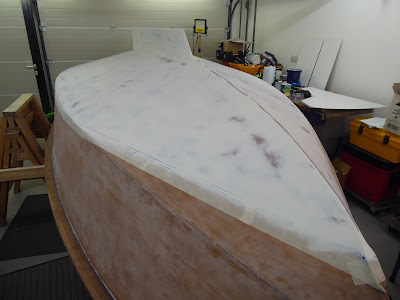
And here is the bottom of the hull fully sanded port and starboard.


I expected the first round of painting the hull to be a learning experience, and it certainly was.

Key lessons learned were:

1. Primer has two distinct but equally vital roles - to provide a) a solid colour base and b) a perfectly flat surface for the gloss.

That means several coats sanded to a really fine finish, with no bare patches.

2. Despite the manufacturer's recommendations, there was no way that a really nice finish could be achieved without thinning or conditioning the gloss.

So some experimentation was required before we painted the hull. Again.

I decided to try proper paint conditioner, as shown in every 'how to paint marine gloss' video that I had seen.

The stuff that seems to be available in the UK is called Owatrol.

It's only available in trade outlets and is ferociously expensive, so a I bought a small can for the trial.

Here it is.


The instructions tell us that it should be added to paint between a 5% and 20% ratio.

So I mixed a quantity at 5% and applied it to the centreboard by way of a test. This is what it looked like.


Not too bad at all!

I also glossed the drop boards, like this.


Encouraged by the improved results I applied two test patches to the hull, as here.


I tipped out one patch with a foam brush, and the other with a bristle brush, to see which gave the best results.

So now we wait and see how it dries, and if this is the way ahead. 

Hull Bottom Panels | More Primer & First Gloss

I haven't posted for a while because there simply hasn't been anything of great visual interest to report.

I have spent the last few weeks learning how to paint a boat, or more specifically how to use marine paints. It doesn't behave anything like household paint, and advice on what to do with it varies widely.

In the previous post I had sanded the bottom panels to a really smooth P120 finish and was ready to repaint them with primer.

More primer arrived a few days later and I prepared to thin it, as recommended on the 'how to apply primer' video tutorials which I had researched.

So I read the instructions on the tin before proceeding, and was dismayed to read "Do Not Thin".

Hmmm. I called the paint manufacturer and asked them about thinning the primer. They said that would be OK for spraying, but 'not recommended' for brush and roller application. In other words, don't do it.

The new paint certainly flowed better than what I had been using, so I showed good faith and applied three coats over several days by careful rolling and tipping.

This is what it looked like.


It didn't look too bad so I went ahead with the first coat of gloss.

Again, this is what it looked like.


I wasn't convinced that it was good enough, so left it until the following day.

Thursday, 25 November 2021

Primer | First Coat & Rework

With the waterline now correctly in place it was time to apply paint. This was truly a momentous step in progress!

The primer undercoat for the bottom is white, and that would be the first paint to be applied.

A previously opened can was reopened and was found to have gone off, so a litre of expensive paint went to waste.

A second can was opened and the first coat was applied to the hull bottom, centreboard, drop boards and rudder.

This is what the hull looked like.


It was pretty patchy, unsurprisingly.

A second and a third coat were applied which covered really well but there were still very  visible brush marks after the third coat.

There should not have been any because I was using the recommended technique of 'rolling and tipping' which entails applying paint with a roller and then tipping it out with a quality paintbrush to remove the air bubbles and brush strokes.

There were no air bubbles but the finish was not good enough for a top coat.

So I looked at a few 'how to paint primer' videos on the internet and realised that that I had done two things wrong.

I had not thinned the primer to allow it to flow freely, and I been applying paint from the wet edge outwards instead of in the other direction.

Thus the paint was too thick and the brush dragged on the wet edge.

So.. back to square one. I would clearly need to repaint the bottom of the hull.

I wasn't too disheartened because I treated this as a learning exercise on a part of the boat which no one would see, so it was OK to mess up.

Accordingly I sanded the bottom panels to beautifully smooth P120 finish. They looked like this.


It was as expected very patchy and would need to be repainted.

I had run out of white primer, having used two litres to get thus far.

This was a Friday evening of course and it would be the middle of next week before more paint would arrive, so things are at a temporary impasse.

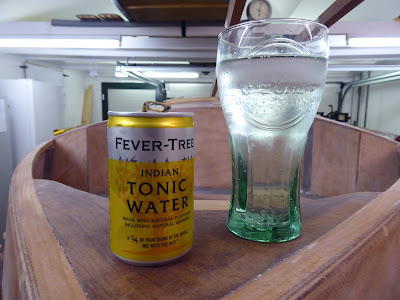
Time for a G&T.


Waterline | Marking Up - Twice!

The build manual states that the waterline on the prototype was set at 16 1/2" above the bottom of the keel, so that's where I marked it in. Like this, using a rule and a tape measure.


Then I used a laser level to mark the waterline across the transom, as here.


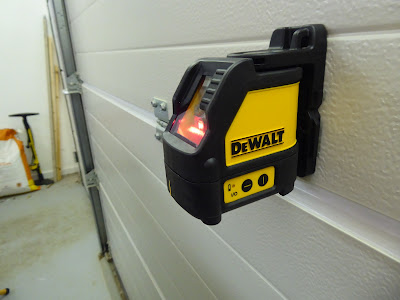
This is the laser level itself.


I initially bought the cheapest I could find, reasoning that I didn't need a quality instrument for such a small job.

Big mistake. The cheap level was rubbish and was promptly returned to the store, and this one was purchased instead. It worked perfectly and I am very happy with it.

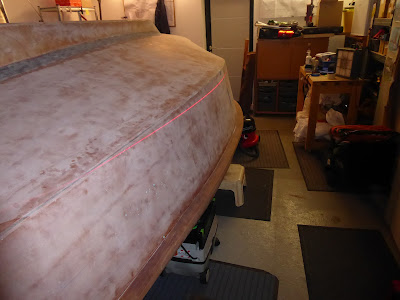
I pencilled in the waterline across the transom and used the laser level to continue the line around both sides of the hull. This is the laser line on the port side.


I pencilled in marks at short intervals and joined them with a straight edge to get a nice, fair, flowing waterline.

Here the line is crossing over the chine on the forward end of the hull.


So far, so good!

Happy with progress I taped in the waterline using some 3M Fine Line tape. It's really good tape, and conforms easily to curves.

Here is the view from the starboard bow.


But I soon realised that something was not quite right.

The waterline was symmetrical until it passed over the chine and back to the transom on the bottom of the hull. At this point it joined the transom at slightly different places port and starboard.

After some head scratching I worked out that this could only be because the hull itself is not perfectly symmetrical. The difference was very small - a few millimetres - but of course over the length of the boat this is amplified to a visible extent.

Given the method of construction this is clearly going to be an unavoidable issue. I needed to find a way to do this correctly.

I needed a datum point on the hull where I could be sure that the waterline was in exactly the right place.

As is often the case with PocketShip there is no such measurement in the drawings, so I examined photos of the prototype and noticed that the waterline crosses the chine at the front of the boat exactly below the forward edge of the forward porthole.

I used the laser level to check this on my boat and immediately saw a problem.

This is what the starboard side looked like.

 
It's way off where it should be, and wasn't even the same on the port side!

So off came the tape and the incorrect pencil line was sanded off.

Then I marked where the line should cross the chine on both sides and used the laser level to mark it from that datum point.

That went well and I now knew that the line on each side was exactly where it should be. The tiny visual discrepancy at the transom was removed by adjusting the waterline by a fraction on each side.

That looked great and I was happy, so a second waterline was taped up. Here is a view from the starboard bow.


That was very satisfying in a perverse and masochistic way! 

Levelling The Hull - Again!

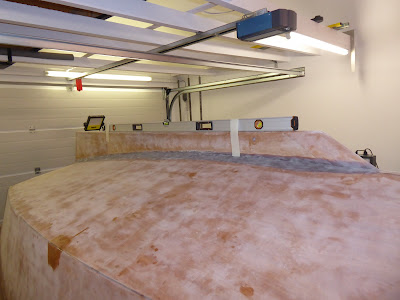
I wanted to be certain that the boat was exactly level when I marked in the waterline, so I double checked using a long level taped to the keel, as here.


I had previously only used a short level to do this, and sure enough the much longer level showed that the hull was not level fore and aft.

A similar exercise on the transom showed that it too was not exactly level, like this.


So the bottle jack was employed to level things up at the stern, as here.


And at the bow.


All was now ready for the waterline to be added.